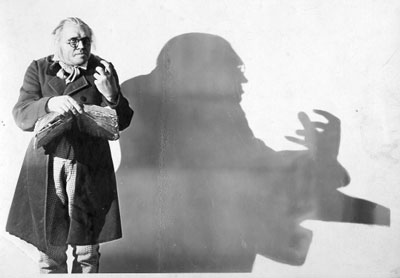
There seems to be much discussion about the framing device used in “The Cabinet of Dr. Caligari” – did it add or detract to the original plot? Was it a shameless tack-on or a calculated plot device? After seeing the way many others perceived it, I realized that the framing device struck me differently.
Despite the common perception that the frame sets up Francis as insane, by the time the film returned to Francis in the asylum, I had become thoroughly entrenched in his story. When Francis entered the asylum and encountered the other characters, I found myself thinking of Francis as the only sane person and all the others crazed. Even when “Caligari” and the other doctors came to sedate Francis, I viewed Caligari as the one who was off-kilter; it seemed to me that, rather than Francis being insane, Caligari had twisted the rest of the world into thinking he was insane (think Invasion of Body Snatchers, say, with Caligari as the orchestrator). It was as though Francis, who seemed very much sane in the opening scene, had, in the time it took to tell his story, wandered into the sinister world of Caligari; here, Francis, like Janowitz and Mayer, was the only one left to see the true madness of this world. This impression lasted only for a moment, but its impact remained.
The reading, then, helped me to elaborate on this idea – did Wiene’s framing technique scrap the idea of resisting tyranny, or did it simply replace the “happy” ending of tyranny’s fall with a darker one that reinforced the omnipresence of the tyrants?
Maybe I’m just the crazy one.

No comments:
Post a Comment