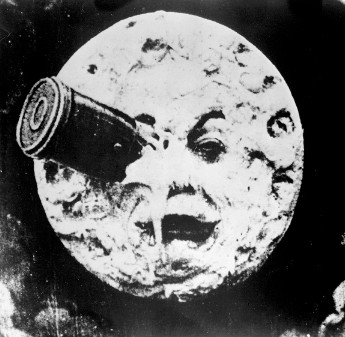
Georges Melies was an extraordinarily talented man who helped transform early cinema into the form of film that we know today. After viewing his film A Voyage to the Moon multiple times, I am astounded by the fact that the film doesn’t appear as “old-fashioned” as I expected it to. When I first thought of the cinema of attractions, I imagined movies that were almost archaic in nature. However, I was pleasantly surprised by the number of scene changes and the presence of special effects in this film. The fact that Melies actually edited his film shows just how innovative he was. Of course this editing was very primitive, but he broke away from his predecessors when he allowed the camera to be stopped between scenes. This added endless opportunity to the art of film making and helped to begin the shift towards narrative based films. Melies’ creativity is another aspect of this piece that thoroughly impressed me. For example, the moon shot that is featured above has now become a cherished work of art in the realm of cinema. Melies created this image with the sole purpose of entertaining and wowing his audience, but this piece represents how ahead of his time Georges Melies was.

There has been a strange parallel between this class and my film analysis class. In both I watched A Voyage to the Moon, Arrival of a Train, and Workers Leaving the Factory. We watched a particular cinema of Attractions film called the Electrocution of An Elephant in the film analysis class. The film basically shows a group of people wiring an elephant in a field and electroucuting it. The elephant instantly drops and twitches and dies.
ReplyDeleteThe entire idea of Cinema of Attractions seems to be based on showcasing movement and life. Noone as yet in this period we're studying, films inanimate objects such as rocks and stones. But after seeing the Electrocuting An Elephant film, I think it brings up a question of how altered reality becomes when viewed on a projection screen. I wonder if people in the era of the Lumieres and Edison felt disturbed by the image of the dying elephant or if they felt a sense that it wasn't quite real. No doubt, film would be the first case in which people could view the act of death repeatedly. Would that necessarily make the death less significant, as though the subject is still alive? Reliving the act of death (oxymoron) would be surreal for the first film watchers I imagine.
On a less philosophical note, I was wondering if anyone figured out how Georges Melies came across figuring out how to make fading transitions. They seem way ahead of their time and very complex to conceptualize for the first time.
I'm sorry I wrote all of that on your post Sarah. I haven't quite gotten the hang of how to post stuff on this so hopefully I'll figure it out next time.
ReplyDeleteIt's all good. All you have to do next time is hit sign in which is in the top right corner. Once you enter your user name and password there is a blue button that says new post.
ReplyDelete