Wednesday, September 30, 2009

The "Trade "Tattoo"

Trade Tattoo, despite its overtly apparent business agenda and British Postal Service, has a rebellious nature about itself. The film attempts to seek something deeper than the strict confines of BPS (British Postal Service). It seems to glamorize and accentuate the importance of mail is to the state of the British economy. On the surface, the message conveyed seems to go along the lines of how BPS connects the economy. However, the producer of Trade Tattoo redefines the purpose of the commercial and in the process of doing just that, reveals to the viewer an unprecedented stroke of insight that is of dazzling nature. This is Trade Tattoo.

the british are coming?

I found the comparison of Grierson's film with Vertov's film to be extraordinarily interesting because, as a history nerd, I thought it somewhat contradicted the general tone of the time. The British were always the first and best of everything- they had the best navy, the best policies, and they had always seemed to remain sort of an elitist island through the trying times of depression. The Soviet government has always been depicted (perhaps just from the American history perspective) as backward, almost agrarian, and controlling. Film trascends these stereotypes. I found it impressive that the progressive and pioneering nature of avant-garde was more prevelant and explored throughout the Continent and Soviet Russia. I think this shows that avant-garde really is a movement from within; it is the individual's desire to explore an idea and develop it to its fruition. This is more difficult to find in its raw states in pompous and successful nations such as Great Britain.

Leonard Charles Huia Lye


Len Lye, whose birth name is shown above, is truly one of the most interesting people that I have ever read about. Aside from an obvious talent in filmmaking, Lye’s tale also includes an intriguing past. He was born in New Zealand and eventually worked his way to America by being a coal trimmer on a steamboat. Before learning that Lye was from New Zealand, I was actually reminded of a picture of a Maori chief while watching Trade Tattoo (see left). The influence of Maori influence on his work is extremely apparent in the moving shapes that appear throughout this piece. His fascination with the role of movement is arguably the factor that makes his films so appealing. Interestingly, I was also reminded of the AOL “You’ve got mail!” greeting during this screen, and I wonder if anyone responsible for creating that ever watched this film. Lye’s talent for creating eye-catching advertisements is fascinating. It’s weird to think that Shell was a major company as far back as 1936 when Birth of a Robot was made. It would be cool to see a modern commercial that followed in Len Lye’s footsteps, but one can safely assume that Shell, a company that is deeply involved in NASCAR to reach its target audience, would not be interested in creating an avant-garde advertisement.
Len Lye's Trade Tattoo was intriguing and entertaining, especially following the dull and boring documentary called Industrial Britain. Not only did it combine actual footage along with animated shapes and things it compiled it all into a montage of sorts. Also the music that was used kept up with the pace of the visuals adding to its charm. One thing that I didn't catch onto until closet to the end was that it was actually an advertisement for the postal services. The flying envelopes and messages informing the viewer to "post mail by 2pm" finally made sense once this became clear. We talked about in class how they funded the film and after providing the money to produce it they informed Len Lye that he had to incorporate a message about their services.
This week of films definitely improved from the previous in entertainment after Industrial Britain, the films became shorter including two advertisements and a short film about a dog’s dream. Just in general, the night seemed to be uplifting instead of an attempt to force ideas into our heads without straightforward about the implications they wish to get across. It was a breath of fresh air to see simple films without dark and twisty backstories.
From last week's screenings, I think I most liked Jack's Dream. It was short and had a childish feel to it, especially with the lullaby-esque Claire de Lune playing in the background, but I found all of that charming, even captivating. The story was definitely one of the lighter ones we have seen, entailing mainly a dragon chasing a woman, whose only defense was a barking dog. But, the total aesthetic of the film was a good ending note to the night.

On the other hand, I really disliked the documentary-style Industrial Britain film. Compared to last weeks Man with a Movie Camera, this look at industry in the lives of a country was far less captivating. There was very little creative editing, much unlike Vertov's innovative cutting techniques. That along with the blasé narration made the film even more like a History Channel special rather than a unique exposure of city life.

This film was also extremely romanticized. The entire thing looked simply at hard labor, whether working machines, coal mining, glass blowing; none of the things it featured were at all as positive and great for the people doing them as the cheery English narration portrayed them to be. Sure, they may have made Britain a great industrial powerhouse, but they did little for the workers performing them, considering the terrible labor laws of the time. Had there been no narration, we would simply have seen a rough look at the lives of various laborers, which could very well have been taken as a sort of exposé on the labor laws of industrial Britain. The movie was a sugar-coated by the narration in an attempt to become a layered film like Vertov's Man with a Movie Camera.

Advertisements and Dreams

I really liked the advertisements that we saw on Thursday, because they made me question modern advertisements. We don't have any commercials nowadays that are anywhere near as much fun as those two ads were. Trade Tattoo was an unambiguous call to believe in the British postal system. It was a really interesting and fun film to watch however, due to all the crazy animation and entertaining music in the background. Nowadays, all of our commercials run in under 30 seconds or so however, Trade Tattoo was much longer than that, and yet I didn't feel the need to change the channel or walk away from the screen. If modern advertising was as entertaining as Trade Tattoo and The Birth of the Robot, the advertising industry would find that consumers would be more willing to endure advertisements.

I also enjoyed the last film we watched on Thursday, Jack's Dream. It was very whimsical and fun, but made me wonder if there was a deeper meaning embedded in the film. Was it exploring only a convoluted dream, or was it exploring the nature of dreams as a whole and the human desire to be thought of as heroes? Just something to consider. Also, I was going to post early, but I forgot and am now out of rhythm.

Len Lye--is that his real name?

I really liked Trade Tattoo. I liked it more because it wasn't Industrial Britain, and even more because it took some of that footage, saved and reinvented it. It was clear that Lye was really inspired by French and German filmmakers, most notably Hans Richter (specifically in ideology, with the whole idea of breaking down motion in order to create something real). I've re-watched Trade Tattoo twice since last Thursday, once with sound and once without, because I was intrigued by what Lye says in the interview we read about how as a silent film, it would look "terrible." I expected that he was just being his own worst critic, but he was definitely speaking the truth. I wouldn't say terrible, not by any means, but the film just doesn't click without sound--it's not nearly as interesting or captivating. It was much easier to lose focus in what I was watching.

I was interested in this idea of the necessity of sound because this is one of the first films we've watched where the sound is married to the image. Unlike the music that originally would have accompanied Dr. Caligari, this music (and only this music) was made specifically for this film. It seems like the sound is as critical to Lye as a filmmaker as the image is. In his interview, he talks about at times designing images that "look to [him] like sound sounded." He also talks about sound sometimes simply adding texture to image, but it is clear that these two concepts are extremely intertwined. This is definitely something new for us.

Also, I agree with the post below me. Why don't they make commercials like this anymore??

Stop Motion Animation

Len Lye's The Birth of the Robot was a neat short animated film, even though it ended up as an advertisement. I don't think Lye's films becoming advertisements is such a terror to his art. It's not as different as the product placements now seen in most commercial films. What I love about The Birth of the Robot is that the Shell Oil message is obviously tacked on, leaving the brunt of the film out there and available for appreciation.

It's a curious surreal reality that the animated characters exist in. The focus on technology, with a Robot in the title even, is treated well by stop motion. The texture most readily reflects the actions of technology inserted into real life. Now that we have robots hanging in the horizon, it's lovely to see the whimsy of a robot origin story appear on film. I'm a little ill at ease that the birth of the robot is created by the death of the human character in film, but I really appreciate the time it took for Lye to create the film.

Who is Rose Hobart?

What I loved about Joseph Cornell's "Rose Hobart" was that it made no pretenses of being anything beyond what it was. The film made no grand statements; it was simply a film collage of scenes with the titular actress in scenes from a forgotten 1930s B-movie, "East of Borneo." It is a film that would hardly be expected to interest anyone beyond similarly creepy admirers of Rose Hobart. The film is undeniably weird in its repetition of seemingly random scenes, and it evokes a curious mix of nostalgia, obsession, and absurdity - all without the use of words and without filming any of his own material. Cornell's film for me is indicative of what can be so fascinating about film; what a movie like this shows us is that our definition of film benefits greatly by being expanded beyond the confines of mass entertainment. "Rose Hobart" works because it is so personal and so defiant of conventional analysis...How can we really be equipped to 'like' or 'dislike' this movie when it asks neither of us. It is simply a personal statement, an artist's product. And honestly, by the end, I was genuinely curious: Who the hell IS Rose Hobart?

Advertisement

I really enjoyed this past Thursday's viewing. Thinking about the sheer amount of time it took to animate before computers is mind-boggling. I think in a way it allowed for a greater amount of artistry and finesse, since the hard-earned product was, in fact, hard-earned. Although I admired the creative force behind Trade Tattoo, the one I most enjoyed watching was the Shell advertisement. As a commercial, it kept the consumers interested in the company, to see if new commercials from them could compare and, in that, I think it was a very strong advertising move. Commercials now are limited to somewhere in the vicinity of a minute, which really only allows for the consumer to catch the company and product names and time to admire the commercial's music selection. This advertisement in particular was showing a novel animation concept alongside a plot line. You then attach the story and appreciation for the amusement you gained to that company, and you will maintain the idea in your head that that particular company is a good option, as you were duly entertained.

Advertisement is a way for a company to make you aware of their products, Most of the time you won't realize that the advertisement affects you. I think that this is an interesting point in the looking vs. seeing debate. If something you see impresses on you what is being offered, though you yourself are only looking, then isn't that seeing? This raises the question of whether or not you are 100% in control of what you allow to impress upon yourself. If you don't look, can something still force you to "see," but through a sort of inverse, wherein you yourself are not seeing, but you saw. I can't find the right words, I think, to make this as understandable to all of you as it is to me; this idea is hardly tangible.

Here's something interesting:

British and American Avant-Garde

I thought it was interesting how different the films from the United States and Britian were from their European counterparts. The English film, as someone else mentioned, just seemed like a drab, boring version of "Man with a Movie Camera." It seemed like they were trying to explain their own industrial revolution and its implications on daily life, but with out the premise of "universal language," it just felt like a boring documentary. And it was a shallow kind of boredom, unfortunately. I am very glad that we were not forced to watch the longer film on fisherman.

That being said, I was really perplexed by the American film "Rose Hobart." It seemed like there was some story-line in the film that I couldn't find, like the narrative was just beyond the tips of my fingers. I understand that this film was composed of different clips from the actress Rose Hobart's films, and I think its interesting that it stands on its own. Sometimes collaborative efforts like that fall apart, and you need an understanding of the original pieces to appreciate the end result. The vague story and interesting imagery of "Rose Hobart" was enough to keep me interested with out being invested in the actress herself. In this way, the film maker created a cine-thing with a montage of images and clips from other films.

Oh, and I really liked the animation that we watched. It was fun as well as thought provoking.

Tuesday, September 29, 2009

AvantGarde Animation

It was interesting to see how filmmakers brought the idea of animation into avantgarde cinema. I really enjoyed Trade Tattoo and the bright colors and interesting mix of rudimentary animation that really caught the viewers attention, despite the fact it essentially was a commercial for the post office. It is slightly redeeming that Len Lye at least tried to stick to his avantgarde aspirations even with the pressure to advertise the post office.

My favorite film from Thursday though was probably Jack's Dream. Not only was the concept amusing and enjoyable but seeing what was probably the beginning of Rudolph or Mr. Rogers types of animation (as Seannie said) and filmmaking was interesting. It was also something to note that these types of filmmaking began as something avantgarde and relatively not mainstream to become something that is the focus of young children's entertainment.

On the other hand, as discussed in class today, you cannot ignore the droning and terribly mundane quaility of British Industrialization that seemed to do nothing more than fail at attempting to copy Man With the Movie Camera.

Monday, September 28, 2009


I loved the lubricant ad. Yes, the lubricant ad. Or maybe it was an oil ad. Anyway, that one got my attention from the get go. The animation of it reminded me of those old Christmas specials on tv like Frosty the Snowman and Rudolph. I love animation; the ability to bring things to life before a camera lens through clever tricks and manipulation has always been something I've loved. Inanimate objects can move how you want them to. I don't think I really understood any of the films we saw last week. However, I now want to see a Rose Hobart film and will always send my mail out early..

Sunday, September 27, 2009

A Reflection

Joseph Cornell's "Rose Hobart" was not as weird as I thought it would be. This is not to say that the film was without its unusual features....

IN OTHER WORDS....

I had no iota what was going on. I was confused in pretty much all the movies. Just "Wow...." There really are no words to describe the films we saw last Thursday.

Thursday, September 24, 2009

Life in Movie form

What is the definition of life and how can we project this definition without excluding any of its important elements? I believe this is what the film The Man with a Movie Camera was trying to express. It was pleasant because it didn’t have words, just emotions. I felt the aspect of an international language was executed well. Watching the film, I didn’t feel pressured into following stereotypes or common assumptions about people. I was witnessing the lives of those just like me; brushing their teeth, playing games, getting mesmerized by magic, etc. I wanted to be as happy and innocent as the children were, yet I wanted to be as wise and knowledgeable as the elders. I sympathized with the poor, and I appreciated the kindness (or appearance of kindness) of the well-to-do. Over 85% of the people in the film were smiling and seemed genuinely happy, and I wanted feel that way too. It made me feel like life is good and although everyone is different and unique, we are all united by this thing called life that we have to go through. This film inspired me to appreciate humanity and how we are linked together by the things that make us vulnerable.

Man With A Movie Camera

Dziga Vertov's film to me was an exercise and exploration in watching. From the introduction, there is a display of empty movie-theater seats that are soon filled by a huge crowd. This film was very self-conscious of the fact that it was a film.
The camera, no matter what it is filming, always puts a perspective or spin on the movements taking place. Framing immediately changes everything. So no matter how much of the "real" world Vertov shot in this film, the editing and choice of positioning and lighting and creation of montage made it very clear that Dziga Vertov was saying SOMETHING underneath, or on top of, all the seemingly "everyday" shots.
I thought that the film was simply an exercise of this idea of the camera as a altering force on reality. The ideas brought up in class about a "big brother" type of message with all of the eyes seem to me to be products of a post- 1984 era. I could be wrong but I doubt that Vertov created such an encompassing, and grandiose film to achieve just that.
Watching the film, I felt as though something was progressing and building up. There were so many reoccurring themes and symbols that led me to this feeling. However, by the time of the end of the film I was completely lost in the boring excitement of the everyday lives of these people and the man filming them.
Man with a Movie Camera was different than any of the other films we have watched, and is my favorite so far. I thought the attempt to create a "universal language" was noble, and that Dziga Vertov succeeded in creating something that was not specific to any language or culture or class of people. The film simply showed life going on with no opinions or prejudices from the film-maker forced on it. I feel that by not having actors or lines or sets, Vertov was really able to capture the beauty in the mundane moments of life. By not imposing any agenda or expcations, the film captures what some may consider the most important in life-finding joy of the "little things." Althought there was much beauty and happiness in the film, there was also sadness and filth. Life is not always pretty, and Vertov presented the harsh realities too. Homeless people sleeping on park benches, trash in the streets, and divorce are some of the less glamorous parts of real life that Vertov showed. In my opinion, the juxtaposition of idealistic beauty and harsh reality was the film's main strength. It showed us what one person is capable of, but may never see. The camera becomes the eyes and means of observation of the people and gives these scenes a permanence that they would otherwise not have if only stored in the fallible human memory.

a truly international absolute language

I was a little skeptical of the opening credits of "Man With a Movie Camera." They claimed that this was an experimental work--right away I recognized that word as a component of what we have thus far defined as 'avant-garde.' I guess I felt that this aim shouldn't have to be expressed so bluntly. Something about that straightforward statement of purpose made me ready to question what it was that made this film a part of the group we've seen so far.

After experiencing those 68 minutes, I'm glad Vertov included those explanatory credits. I really felt that this goal of creating something universal with film was accomplished. It was interesting talking to my classmates about "Man With a Movie Camera" after the screening, because it was reminiscent of leaving a movie theatre after seeing a movie I had been excited about seeing, despite having no real concept of this film beforehand. We were all piping in with our favorite parts, comparing notes--sharing some basic understanding of what we had just experienced. This film had a happy ending, I thought, which made me feel entirely different than I did stepping out of the UL two Thursdays ago, for example. There was something romantic about this film, perhaps derived from its honesty--its dedication to real life in combination with the novelty and grace of its editing. O'Pray notes the "paradoxical nature" of "Man With a Movie Camera." It, like other Soviet films of the time, was intended for a mass audience and produced by a state trust, VUFKU. Although these facts seem to go against the individualism and distrust of the mainstream that we've been associating with avant-gardism, "Man With a Movie Camera" is, in my mind, still avant-garde. It may not have a strong sense of violence (although there are certainly some violent images) or distrust of authority, but I think what it has commonality that is more important--a desire to advance the practice of filmmaking to something more than an art (an absolute language!) as well as a fascination with the "magic," the origins of cinema.

window to the soul

Man With a Movie Camera offered a refreshingly simple outlook on life. One interesting motif I noticed while watching the film was the repetitious scenes of people cleaning themselves. Crowds of commoners gathered at the beach to wade in the water. Children and men feverishly scrubbed their skin with water from a trough or a pump. Some women modestly cleansed their faces within their own homes, while others received pampering facials at the spa. Everyone, from all social classes and walks of life, partakes in some sort of cleaning ritual. Yet these scenes were frequently juxtaposed with scenes of filth. Men, laboring in the factories, wiped the soot and sweat from their brow. Women smeared their bodies with mud (true, to soften their skin, but still) while their children ran about in the dirt. Viewed panoramically, the streets appeared relatively clean and well-maintained, but the film was sprinkled with shots of the homeless, sleeping in rags on benches, parked on sidewalks littered with trash. The shots of people sleeping, especially of the young woman in the beginning of the film, seemed very intimate, and a bit intrusive. I feel like the shot of the blinking of the woman's eye switching to the shot of the camera's eye, and again to the shot of the flickering blinds of the window pretty much summed up how the camera is like the eye because it serves as a means, or window, through which we can view the soul and the human experience.

The Beauty of Everyday Life

"Man with a Movie Camera" is different from any of the avant-garde films we have seen so far. It is about the beauty of everyday life. I agree with the poster who mentioned that the film is a way of recording life's ordinary yet beautiful moments whose details humans are unable to preserve. The music was very moving for me as it allowed me to fully connect to why Vertov made this film. The soprano's beautiful voice not only went well with the various scenes of the women, but also made me realize the amazing capabilities of the human race.
I also noticed the importance of contrast in many aspects of the film. This included contrast in social class between those filmed. This was evident in many scenes, including the ones of people riding in streetcars while others rode in a horse and buggy. This contrast might not only have a political meaning, but it added to the visual rhythm of the whole film that was so intricately created through the use of specific editing techniques, including super-imposing and split-screens. I especially found the interweaving of images portraying marriage, divorce, birth, and death to perfectly portray the stages and moods of life. Overall, I was pleased with the film "Man with a Movie Camera". It reiterated the idea of cherishing life’s everyday moments.

The power of film

Although it's certainly up for interpretation, the message I took from Dziga Vertov's Man With a Movie Camera is that film can go anywhere and see anything. By covering the minutiae of a city (women riding in cars, the work of a single factory employee) and especially by superimposing images of the cameraman in physically impossible situations (i.e. a massive cameraman looming over the city, or a miniature cameraman inside a bubbling glass of champagne), Vertov shows the viewer that film has the power to observe anything.
But Vertov does not limit his message to shots by the cameraman-- he includes shots of the cameraman as well-- weaving through traffic, bathing in the ocean, balancing on the side of a moving car, but always holding onto his camera. In this way, Vertov conveys the ubiquity of film very cleverly. He not only shows the cameraman in a variety of situations (proving he can go anywhere), but implies the presence of an unknown, invisible, second presence (maybe the audience?) by the very fact that he has these shots of the cameraman.
Overall, I looked at Man With a Movie Camera as a fascinating examination of the nature of film and the interaction between the cameraman, his subjects, and his viewers.
Also, I loved the music; just had to get that in there.

Although I cannot say that I am quite as thrilled about Vertov’s Man with a Movie Camera as some seem to be, I do appreciate the idea and find it rather intriguing. The idea of the universal language and communication across languages is a beautiful concept although I feel that in a way it was just an idea used to glorify filmmaking. As if to brag that filmmaking is the superior art form because it can be universal and not limited to one language. The film also seems to show that the video camera surpasses the human eye. It shows how much more the camera can capture than what we may see with the human eye. The camera switches back and forth between what the camera sees and the bigger picture of the man shooting the film to show the subtleties the camera is able to pick up. Sometimes throughout the film the scene would freeze to allow the viewer to focus on a snapshot. This is another thing the human eye is unable to do. We do not have the ability to freeze a scene to give us more time to look at it as the camera did mid men jumping hurtles or horseback riding. I feel like though the film was extremely experimental and the overall purpose was a universal language, its purpose of glorifying filmmaking, or the “kino eye” as Vertov referenced it, was just as prominent.

Vertov's Film

Watching this one gave me the feeling like the entire world was one living, breathing organism. It took a variety of activities which we see as mundane, and revealed them to be the universal tie between all people. This wouldn't've been so clearly portrayed if this movie were made of scripts and actors instead of real life footage.

This film allowed us to see more of the lives of the people in the past than we ever would have otherwise. I feel like I'm let in on a secret. If no one ever recorded daily events in a film like this, how would we ever be able to experience what it was like to wake up in Russia in 1929? I appreciate this film because it recorded things that usually go unpreserved in favor of more monumentous subjects. I thank Vertov for taking the time to appreciate the beauty of the world around us. It's one thing to know that people lived life and went about theyre business 70 years ago much like we do today-- that is an undeniable fact. However, when you have tangible evidence of their lives, it makes one feel so much more connected with them.

Wednesday, September 23, 2009

a man with a mission (and a movie camera)
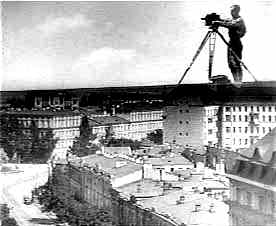

Dziga Vertov’s Man with a Movie Camera is more than a guy randomly shooting happenings of everyday life. This piece is a true avant-garde film that attests to the style’s desire to break apart from the norm. Vertov pushed the boundaries of cinema at the time with this movie in many ways. For example, the piece contained absolutely no scripted action or even actors, unless you count the camera man. Also, this film works to establish film as a truly unique venue. As the opening subtitles of the piece state, Man with a Movie Camera sought to create “an authentically international language of cinema.” The O’Pray reading further expanded upon Vertov’s intention of standing apart from his companions by discussing Vertov’s idea of “perception as a revolutionary act.” Not only did Dziga Vertov step outside the boundaries of cinema in idealistic aspects, he also pushed the envelope with his style. This piece contained stylistic elements ranging from super-imposed images, like the one above, to stop motion techniques. Sound is another important factor in this film. While the version that we viewed contained a modern soundtrack, the original was a silent movie. I believe that the sound was an excellent addition because it helped the audience to better differentiate between scenes. Overall, Vertov’s investigation of Russian life in the late 1920s was a piece that I thoroughly enjoyed watching.
Going into our last screening, I found myself with high expectations for Man with a Movie Camera, most likely due to the planted seed from the last German 060 class calling this movie their favorite. In the first few minutes, I grew slightly confused as to why anyone would prefer this film to something full of twisting plot like Dr. Caligari. But then I was drawn in by the music and the beauty of the mundane being filmed.

Yes, the music definitely played a role in how much I enjoyed the film, as it does with so many. I love orchestrations and big bands, the music of the era of the movie. It fit so well with all that was going on, not in a way that seemed planned necessarily (for instance, there weren't many points where things were obviously in sync with the music), but one that just seemed natural. I thought it really enhanced the whole film experience

I also thought the film's focus on women and their activities was really interesting. In a time when women were just beginning to gain rights and independence, for a man-made film to recognize such things is really intriguing. We talked about how the filmmaker often showed the outside or the surface of things before going inside their workings. Perhaps one of his points in showing all of the women doing everyday things was to show how vital a role they do play in keeping things together or making things work?

Seeing the man with the movie camera appear throughout the film was also really cool. I thought it was a subtle way to tie the movie back to being theatrical; as the beginning credits said, it was to be without a plotted story, but seeing periodically the man with the movie camera kept the raw pieces strung together.

Universal Language

A Man with a Movie Camera was really captivating for me, but in that, I can't separate the visual component from the music, added later. Both have a lot of energy and give a lot to the film, but it would be a different experience without the music. Would the experience have been less interesting?

Vertov mentioned in his essay that he thought of music as helping us to "hear" like how a Kino-eye helps us to "see". I got the sense that as much as the movie was trying to show life as art, as seen through the camera, there was also this glorification of the cameraman. A lot of the time he is seen as larger than life, although admittedly the first image is of a larger than life camera. Then the eye is laid on top of the camera lense. It's like Vertov is saying "I'm pointing out the eye of God to you, so you'll know better next time."

There's a lovely "This Could Be Anywhere" component of the film, being silent with just music as its form of expression. But what does that say? This is the human life, laid bare before this man's camera? It's a nice feeling that A Man with a Movie Camera is a universal language, using film as a means of communication and expression, but it was a personal film. The language is still universal, even in a subjective view point.

!!!iiii111llllLLLL7777

A man with a Camera. In my opinion A man with a Camera was, how i said in class, a movie about a viewing the city that he lives in. He sees how the city is filled with people that have their own stories. A story of birth, marriage, divorce many elements are incorporated into the movie. I found it interesting that the director had to incorporate a sort of reminder that the movie was without actors, the help of cinema, set, and plot. The director did a very good job and capturing scenes and peoples faces that words could not describe. For example, the women giving birth the happiness of marriage and the painful reality of divorce. He captured other good scenes as well the policeman working and the women cleaning, the poverty of Russia and the machines working. I still dont know if this movie has an overall purpose except to be different. But I wonder if there is any correlation between these themes and to Russia of that time.

Man with a movie camera

As I was watching this film, I kept noticing a recurring theme and wrote it down in order to try and figure out if the director meant anything by these shots, and if so what I was supposed to get from it. I noticed a theme of two sides to the same topic. I first noticed this when it showed the streetcars going down the road and it showed the same streetcar from two different perspectives. This made me wonder if we, the audience, were supposed to consider this everyday occurence from two different perspectives as well. I saw this theme repeated in a few other scenes as well. There was a scene of a couple going to the registrars office to apply for a marriage certificate closely followed by a scene of another couple in the office applying for a divorce certificate. Then there was the birthing scene that was closely followed by a scene of a funeral. These contrasts made me wonder what the director was trying to imply and what message he was trying to convey. Also, the entire structure of the film is a comment to the same theme. The first half of the film chronicles a normal day in the city and contrasts groups of people such as the working class vs. the bourgeoise, the homeless vs. the working, and the working men vs. the working women to name a few. The second half of the movie is in contrast to the first half as it shows a relaxing day at the beach and depicts people having fun, playing sports, and generally enjoying themselves. This reoccurring theme of contrast throughout the entire film made me wonder if the director wanted the audience to open up to both viewpoints on an issue.

A film about film viewing and film making

"This experimental work aims to create a truly international language of cinema based on a total separation from language of the Theatre and Literature."

Vertov experimented with a lot of editing effects in this film. The ones that I noticed were collage, image-over-image superimposing, slow motion, stop frame, stop-action, dissolve effect, and "rewind" reverse playing. I liked seeing how these effects were used along with the content that seems to comment on film viewing and film making. There were a lot of "spectator" and theatre scenes throughout this film. The spectator scenes consisted of clips of typically spectated activities (athletic feats, magic tricks) with clips of various spectators reacting spliced between them. This created an interesting effect where the spectating crowds and individuals seemed to respond to the "viewed" clips beforehand, while it was still obvious to the film viewer that the event clips and spectator clips did not match up. This same effect showed up in the theatre scenes, but in a different manner. Vertov edited the film by superimposing "viewed clips" of film that he shot onto the screens of theatre viewings that he also shot elsewhere. This effect changes the film that the theatre-goers were watching, as made obvious by subtle inaccuracies. Vertov incorporates a lot of other scenes that can be considered casual nods to the act of film making. The viewer sees camera mechanisms throughout the film, for example with the motif clip of the eye within the camera's lense. Clips of the "man with a movie camera" going to extremes (ladders, under train tracks, on moving vehicles, middle of street, etc) to record footage also relate to this idea. Lastly, there is a solid 10 minute section of clips which make reference to film editing. A woman is shown scouring over film - showing single stop frame images - and splicing clips together - eventually showing the extent of the clips that were shown as stop frames before.

a man with a movie camera

What is is about this film that encapsulates its audience? It doesn't have a structure or a meaning or even a purpose except to define life and movement and show the mechanics of life. The drastic contrast between the slow music and the fast provided emotions to the simple images being shown. It was interesting to me how they attempted to show not only what the camera can record but also what the filmmaker does to create its shots. Was this movie created to show love, socioeconomic structure, life, or politics? Or was is as simple as to show what can be created through film. Film has no borders or constraints. Our minds are like our own personal movie camera but the down fall to these is that we have no way of storing each detail we see and hear. So we write it down in a journal or sketch it out while doodling in class but regardless of our attempts we have no physical record besides our memory and the imagination that adds onto our thoughts. That is the amazing ability that film holds which can be seen in "A Man With a Movie Camera" because it proves that anything, not matter how miniscule can be recorded and kept forever.

reversal of symbols

I think what I appreciated most about Man with a Movie Camera was its ability to capture the symbols and common threads of life. I think that the other films we have watched this semester have focused on taking an idea and creating a film from that idea. Man with a Movie Camera does the opposite. It took a film and allowed the idea to flow naturally from the film. This created space for the inhereant universal truths of life to come out and be seen and recognized by all. His desire to simply capture life allowed for the film to develop symbols of its own. I think this is why so many people are drawn to the film- the symbols can be easily recognized and understood rather that having to dissect them to the point of ruining them.
The Man With The Movie Camera was fantastic. I absolutely loved it. The melding of so many different points of view into one all encompassing melange of feeling was awe inspiring. In comparison to all the other films we've watched, it was very articulate by the end of the viewing in exactly what it was communicating. It was a language within itself and, regardless of our nationality or language, we could understand it with ease. I was very impressed with how well woven this story was. Not a single fiber was loose. Every string was purposefully placed where we saw it. The movie to me was symphonic. Everyone played their part magnificently. Happiness, sadness, adventure, intrigue; all of it was real. It's very hard for me to put into those perfect words all the emotion I could feel emanating from the screen in that hour.
The music itself was unbelievable. I believe I speak for a lot of people by saying that the music was one of the most pivotal pieces of the film. Without it, the movie would have remained a flat screen. With it, corresponding sound would hit the viewer with a wave of emotion that tied you to the concept of the film: to understand without a plot or a story.

Man with the Movie Camera

The film "The Man with the Movie Camera" is by far the best non-narrative film we've seen this semester thus far. I was actually quite pleased that it managed to capture my attention for most of the hour long session, despite its lack of story. I especially liked the ideas that went into making the movie. By taking away the theatrics of cinema with no acting cast, no set and no words, "The Man with the Movie Camera" was avant-garde in the sense that it was revolutionary. I would even go so far as to say that it was an active attack against convention films of the time, because the prelude (of sorts) to the film explicitly mentions the fact that there are no theatrics or no specific languge; it doesn't leave the audience wondering whether or not it is something unique.

One of the goals of the film that was definitely accomplished was the invention of a "universal language" without words. The clear imagery and simplicity of the movie made it very easy to understand, and this ease of access is what makes it really beautiful. Anyone can sit down and enjoy this film and take something away from it, though there are some deeper aspects, like the ones we discussed in class, that may not be so obvious.

One of the curious things I noticed during "The Man with the Movie Camera" was how the tempo and rhythm of the images seemed to almost always go against what the score was playing, instead of them being in sync. I'm not sure if that's alluding to the (in)stability of the Russian society of the time, or if it's suggesting that this "Man" is not actually capturing reality as thoroughly as we have been led to believe. Or maybe its something else?

A film about film

What I found most refreshing and most remarkable about "The Man with a Movie Camera" was how Vertov's intentions were so concerned with the development of film as a distinctly cinematic form -- it should not imitate old art forms but rather use the technology available to create something entirely new, vital, and vibrant. It is a daring, fast-moving, and triumphant work that is full of life.
My one issue with the film is that it does not perhaps accurately reflect the real urban Russia that it strives to -- it is much more focused on presenting the image of a bustling, mechanical city life that is a product of Stalin's Great Transformation of Russia into a modernized industrial state, launched into the present through his 5-Year Plans. This is an image instead of a reflection of the poverty and censorship and turmoil that the real Man with a Movie Camera would have also found in late 1920s Russia.
Still, the movie is visually exciting and memorable, leaving us with dozens of beautiful images and scenes. It is a film about film and the making of film, and it daringly succeeds in creating the new, fast-paced international language that it sought to achieve.

Monday, September 21, 2009

Teamwork on Vocabulary?

Hey everyone,
I don't know if I'm late or something, but do you all want to team up for the vocab? I think there's 24 of us, and 96 vocabulary words, so that leaves 4 words for each of us. If I'm way late, and everyone has already started and I'm a loser, just tell me in class. If not, I claim the first four terms. Well, see you in class!

Jade

A Study of Life

I believe that my favorite part about Man with a Movie Camera was its constantly fast-forwarded movement. I'm not sure what the technical film term for that is, possibly accelerated... film? Anyway, it really emphasized how busy human lives are, how much we accomplish in a day at a time. I loved watching the camera man literally hustle and bustle from place to place, climbing steep ladders to the tops of buildings, floating above a dam, walking on beams hundreds of feet above the ground. He would stop at nothing to get his footage, even standing on the edge of a moving car. His deliberate efforts at capturing every day events revealed to me how miraculous and wonderful they were. And yet, at certain moments when the camera focused on one place for an extended time, slowed to slow-motion action, or stopped in complete still shots, I was even more amazed. The part when he filmed the women riding in a buggy and conversing as they took notice of him was so inspiring, simply because the audience was given time to analyze human reactions and appreciate the beauty of communication and body language. My favorite part would have to be the horse pulling the buggy, though. When his motion slowed, as a result of film editing, and he turned to look back at the camera man, my breath was taken away. The curious, yet noble way the horse craned his head; his mane glistening in the sun and waving in the wind; and his body's powerfully rhythmic manner of moving, was majestic in itself. Finally the film froze, just for enough of a moment to appreciate something that usually happens so fast, it cannot be absorbed. Maybe it's just me and my love of horses, but that horse taking notice of the filmmaker and turning to look at him was so beautiful! As for the repetition of the music, I believe that Michael Nyman did this to reinforce the realistic aspect of the film. The movie documented many important aspects of life: birth, working, socializing, having fun, exercising...and these are not things that happen once in our lives. Life is full of repetition, and cycles. When I recognized music from the beginning of the movie playing again in the middle of it, it gave me a comforting, familiar feeling, as though I had just returned home from school. It reminded me that Man with a Movie Camera is not just a film, it is a study of life.

Sunday, September 20, 2009

Man with a Movie Camera

I completely agree with the previous post. I believe Vertov really wanted to illustrate the beauty in what are often viewed as ordinary and tedious tasks, and he succeeded. I mean, the fact that were not only watching his movie, but personally I loved it, is proof of this fact. Additionally, I loved how the beginning began with scenes of empty parks and factories, stationary machines, and the like, which then became scenes all of these things coming to life. It showed what illumination the human presence can bring to a situation. Although sudden and almost out of place, I also think that the shot of the live birth empashized this fact, something maybe viewed as taboo for public camera, Vertov simply used it to explain his argument of the beauty and importance of life. It should not be viewed as disgusting or odd, but impressive and miraculous.

Although I really enjoyed the highly narrative and intruiging storyline of films such as Dr. Caligari, I must say how surprised I am with how fascinating I found Vertov's film, it's simplicity and sincere passion emanating from it enthralled me.

At best, "Man with a Movie Camera" was a mesmerizing film with a lyrical soundtrack put together by Michael Nyman. Although the music was slightly repetitive, it was nevertheless a beautifully, moving portrait of the life it portrayed. The film was provocative in that there reveals an evocative and quite profound element in the most mundane activities of human life. Who knew that such a mundane activity such as the way a woman factory worker does her job could be so engaging? It was as if, the cameraman wanted to illuminate what we miss every day, that there is beauty in the mundane, in the plain, in the ordinary. I found, as I was watching "Man with a Movie Camera", that there was an extraordinary, but subtle paradigm shift within me. There was a certain parallelism to the way the cameraman portrayed the varying parts of human life that almost seemed synchronized. There was a familiarity and a sense of intimacy to the film that I could not put my finger on. There was something strangely exhilarating and uplifting about watching the mine worker do his job. I am still in awe and wonder at "Man with a Movie Camera." Who knew that such a film could be so mesmerizing???

Thursday, September 17, 2009

The Clergyman's Climbing Up the Walls [[avec Coquille ]]

I’ve come to the realization the Coquille et le clergyman is my favorite film of from our last screening. For one, I understood what it was about despite its chaotic use of symbolism. As we watched the film I liked the distortion of scenes and the manner in which the story unfolded. At first I got the impression the clergyman is being victimized by the general, but after a while I began to realize that he was the true victimizer.
[[ reason Two, ]] Since I always relate new things I’m exposed to with old ones I already know, I thought I’d relate this film to one of my 14 favorite Radiohead songs; “Climbing Up the Walls”. This song is extremely eerie and powerful because it has presence every time it’s played. Many say it’s about being stalked or some serial killer; Thom Yorke says he was inspired by the mental asylum he once worked at. Regardless, this song coincides with the theme of Coquille et le clergyman because they share that same sense of chaotic symbolism.i watched the first 4minutes47seconds of the film again while listening to the song and it fit almost like a glove…I suggest you try it; ‘specially if you are a Radiohead fan. The lyrics sum up the chaotic symbolism of the music and the various metaphors somehow suit the film Coquille et le clergyman. [[maybe I’m just daydreaming the similarities but I don’t know how else to explain it other than the combo of the track “Climbing Up the Walls” and Coquille et le clergyman speaks to me]]
“I am the key to the lock in your house, that keeps your toys in the basement
And if you get too far inside, you'll only see my reflection
It's always best when the light is off, I am the pick in the ice
Do not cry out or hit the alarm, we're friends till we die

And either way you turn, I'll be there, open up your skull
I'll be there, climbing up the walls

It's always best when the light is off, it's always better on the outside
Fifteen blows to the back of my head, fifteen blows to your mind
So tuck the kids in safe tonight, shut the eyes in the cupboard
So not cry out or hit the alarm, you'll get the loneliest feeling

That either way you turn, I'll be there, open up your skull
I'll be there, climbing up the walls

Climb up the walls. climb up the walls”
p.s. funny how [almost] everything always seems to be about sex!!!

ghosts

Ghosts Before Breakfast appealed to me more than any of the other films we viewed last week, not only due to its charming, whimsical rhythm, but also because of its unique take on surrealism. Unlike the films which preceded it, Ghosts did not limit itself by only utilizing abstract images to evoke emotion, but also showed its audience ordinary, relatable objects which were presented in such a way that defied the natural rules of logic. Last year, my English class discussed the symbolism of the hat in the Samuel Beckett play Waiting for Godot; this came to mind as I watched the hats fly around the lawn in the film. I think the hats represent reason, and, in that sense, reason had almost completely escaped man.

At one point in time during the film, I became confused as to the presence of ghosts in the setting. Were any of the people “ghosts”, and if so, which ones? Without reason, do we as humans lose all substance, and thus become mere “ghosts” of what we could potentially be? The hats were always just out of reach, and yet, it seemed as though the group of men were approaching the problem with very little rationality. Take for example the scene where the one man aims a gun and tries to shoot another man. Either he is trying to shoot a ghost, which would be pretty ineffective, or he is trying to shoot his fellow companion, which would actually hinder the group’s efforts. Same goes for the scene where two of the men are engaging in a gruesome fistfight. The film displays violence as irrational and inhumane.

Personally, I found the repetitive movement of shapes from several of the first movies to be kind of monotonous. The constant movement really did not grip me and after the first minute merely turned tedious. It kind of reminded me of one of those screen savers that comes up and you cannot stop watching, only someone decided to make it into a movie with sound. I am not trying to put down the entire idea however, because I do truly appreciate the time and effort that must have gone into these films. Especially with limited technology, it would be very difficult to coordinate these shapes to the music. I believe that some of my confusion is probably due to my musical handicap. As much as I would love to be a musical person, I simply do not have an ear for tone or pitch and rhythm is just a whole other level. It was hard for me to grasp the meaning behind it all.

I found myself to be much more intrigued by the film Ghosts Before Breakfast. I have found that I really get into movies when I can relate to them. This film reminded me of those days when nothing goes right no matter how hard you try. Not even the little things. I am not sure that being relatable is exactly what these film creators had in mind, and may even be a shallow idea in comparison, but that is what grasped my attention.

a visual symphony.

Perhaps it was because we watched it first, perhaps it was just the simplest, relatively, for me to grasp; at any rate, Walter Ruttman's "Lichtspiel Opus 1" forced itself a place in my mind more forcefully than any other film we watched last Thursday. Watching the Light Opus, I did not feel affronted, forced to face an inner part of myself as the other films did; rather, I felt invited, asked to slip into the subconscious for a while. I have always been a big fan of music, and I felt while watching the Light Opus that Ruttman had indeed blended the two, light through cinema in perfect harmony with the music. Ruttman, essentially, captured the visual existence of a symphony, in my opinion. On the other end of the spectrum, the film I felt most bizarrely intrigued (and almost, in a way, violated) by was Luis Buñel and Salvador Dali’s “Un Chien Andalou.” At times I did not know whether to be put off by what I saw or laugh hysterically; either way, the film left me far from the serenity placed in me by “Lichtspiel Opus.” And I am sure it has already been mentioned, but of course, I could not help but remember the Pixies song "Debaser." (click to watch!)

It's always hard for me to put down into words exactly what goes through my mind on a topic. All of the movies from last Thursday piqued my interest in different ways. I enjoyed the shapes studies more than the Dali and live-action video because it was so open to interpretation. Sometimes I got the feeling that the shapes had direction and were choosing like an animal what to do. I've forgotten the name of the exact film I'm thinking of, but it was the one with the spikes and blobs of slight colour. At times the blobs and spikes would essentially turn into obstacles and animals simply in the speed and direction in which they moved. It was mesmerising. I feel like that was an essential aim of the director. The timing was perfect in transforming the blob into an animal and the triangles into hunters. That feeling can't really be accidentally created.

Lichtspiel opus 1


Ruttman's Lichtspiel Opus I was most resonate with me than the other movies. With all of these films, there was no distinct idea or thought process that i could clearly discern. But with this first film, I had a base feeling, an immediate contact with something that I can't really explain but remains grasping my mind.
First of all, the texture of the drawings and the color and the animation was very reminiscent to me of the Disney film Fantasia (one of my favorites). I read later that this film inspired the workings of Fantasia.
As for the nature of the work itself, there was something very sensational and sensual about the piece. One thing to note was the repetition of movement, hammering these shapes into the memory. Another was the way in which the light curved. At one point it curved as though outlining the curves of a woman's back. But at the last "movement" (I think), there was a glorious beam of light that protruded in the screen. From this, I got a sense for Ruttman's idea of forming musical ideas with visual ones. Symphonies often end with something invigorating and glorious.
The shapes that were projected on the screen were fascinating. Rhythmus 21 consisted of squares and rectangles, completely mechanical and geometric shapes with sharp edges. Everything in Lichtspiel opus was fluid and human. The strokes felt created by human hands. They weren't completely solid. They faded in and out and changed colors. They illuminated. They weren't just shapes of themselves, they revealed the environment they inhabited. There was a blur between determining whether a background was being illuminated or whether the "illuminations" were inhabiting the background. I assume there was some marriage between the two ideas.
I wish I had gotten to see these films without the music. I know that with the world that I live in, movie without music instills boredom in me. But I still feel as though the music was completely against the intentions of many of the films, especially Lichtspiel Opus. Lichtspiel Opus was a work in creating music through images, so a conceived soundtrack pairing takes away from the artist's purpose.

Understanding the Confusion

Ghosts Before Breakfast was also my favorite of the films we watched last Thursday. For me it was the film I enjoyed and understood the most. The whimsicalness of the moving hats and disappearing people reminded me of the television show "Bewitched." The film also intrigued me the most- I want to know more about the filming or editing techniques they used to make the various objects move. I understood Ghosts Before Breakfast as a portrayal of a day where nothing seems to get done. The use of the clock shows that time keeps on passing but the characters are unable to put their ties on or go down a ladder. This reminded me of various Saturdays where I just stay home doing chores and watching television and before I know it is nighttime.

I found the other films interesting, but I'm not sure I completely understood them. In particular the Surrealist films Coquille et le clergy man and Un Chien Andalou reminded me of dreams in that they were illogical, loosely connected, and featured the unexpected objects like the dead donkeys. I could see how the films are supposed to portray the repressed feelings of an individual that appear during sleep. This would explain the clergyman’s desire for the married woman while Un Chien Andalou expresses the random and unconscious dreams that the human psyche creates.

Here is a title

As many people have already said, I feel like last week's screening was our first exposure to truly avant garde cinema. I also enjoyed Richter's Ghosts Before Breakfast the most, initially for its seeming whimsicality. It felt like the most accessible and, for lack of a better word, friendly of the films we viewed. But to reduce it to an amusing short would be doing it a great disservice. Like many of the films that we watched, Ghosts Before Breakfast disturbed me. At first I thought otherwise, given the playfulness of the images (i.e. the man trying, unsuccessfully, to tie his bow tie) and the music; both initially spoke to me of entertainment, not enlightenment. But as the film progresses, and the viewer realizes that, no matter how they try, the people within the film are unable to accomplish anything (i.e. tying a bow tie,climbing a ladder, or crawling on the ground), and the film becomes slightly more disturbing. In fact, the sheen of quirkiness that entertained me at first became the very thing that unnerved me. The juxtaposition of such an unnerving message with such accessible visuals served the make the entire film much more memorable to me.

I also enjoyed Ballet Mecanique for its visual beauty and comforting message. After a night of beautifully disturbing visuals and uncomfortable messages, Ballet Mecanique relaxed me in a way none of the other films were able to with its quiet beauty and endearing optimism.

Wednesday, September 16, 2009

Utter Confusion

Last week was my first real exposure to true avant-garde cinema. While the pieces we viewed were certainly distinctive, they did not exactly have me sitting on the edge of my seat. The first three films we saw were interesting, but I feel like watching one would have sufficed. Seeing all of them was a little on the repetitive side. In all honesty, I was quite bemused by most of the lengthier films. For instance, Germaine Dulac’s “Coquielle et le clergy man” was almost exasperatingly confusing to me. The unexpected grotesque opening completely caught me off guard, and I couldn’t really follow the action. When Dr. Langston described the movie as a twisted almost pornographic piece, I was baffled. I thought that the beginning part where the man was almost attempting to rape the woman was obviously sexual, but beyond that I didn’t pick up on the sexuality of the piece. Leger and Murphy’s “Ballet mécanique” was by far my favorite work that we watched. I loved the way the filmmakers portrayed everyday movements as acts of beauty. The close ups of the individual features of the girl’s face really intrigued me. I also liked the repetition of mechanical actions. Watching them for an extended period of time allowed us as viewers to truly see the beauty in these commonplace procedures.

A Reflection

Out of all the Avant Garde films we watched last Thursday, the film that resonated most within me was "Symphonie Diagonale. "Symphonie Diagonale", with its striking contrast of shapes and colors left me with a myriad of twisting emotions. Bizarre structures black in and black out with surprising melody with the music. The figures configure themselves awkwardly on the screen as if they were to further perpetuate the beat of the music. I become transfixed by the entrance and exit of the figures, contorting themselves to fit with the music.
In addition, "Rhythmus 21" also left an impression on me. "Rhythmus 21" irrevocably conspired to zoom in and zoom out white boxes that left an imprint upon the black screen. I was glued to the steady, solid beat that the music conveyed to me. Without a doubt, "Rhythmus 21" and its trademark collision between the two white boxes seemed to mimic the blinking of my eyes.
Although, "Rhythmus 21" and "Symphonie Diagonale" were films merely comprised of moving blocks and random figures, both imparted a unique set of sensations that I had not encountered before to me. Moreover, despite what we read in both the textbook and articles on the films, there seemed to be an ability that the message conveyed by both films was open to interpretation.

-Michael Lau
Out of all the films we watched my favorite was the Bunel/Dali film. I really enjoy Dali's art and his style, from the awesome mustache to the trippy paintings. I hate to say it but i really didnt get much out of the other films. I tried but it just wasnt working out and I sort of left the viewing room with a sense of failure. I really enjoyed the music and all and some of the shapes in the movies were really captivating, but I just felt like I wasnt really relating to the films or I wasnt seeing the entire picture. I was especially confused when after the priest film Dr. Langston asked the class if anybody was completely pist off at what we had just seen. That completely threw me off!
But in any case I enjoyed the movies and I especially enjoyed the music, like always.

Lalala

Avant-garde avant-garde avant-garde cinema. Finally. Like everyone else has said thus far, I left the viewing room last Thursday feeling as though we had finally explored some true, classic avant-garde films. Each of these movies blew my mind in a different way and I am so excited to know that we are reaching the crux of the course.

I am still upset to see that people are still genuinely unnerved by Prof. Langston's assertion that simple movement yields complex emotion. I do not necessarily want to speak for him, but I am pretty certain that he did not literally mean that acts of motion underlie human feeling. I mentioned my theory in class, but I am not sure if it was coherent. I think it is arguable that Ruttmann, Richter, and Eggeling were simply aware of subtle influences that the pairing of form and movement can have on the human psyche. They were able to use these common archetypes of movement and emotion to hopefully pioneer a new sense of expression and evocation from film. Sure, we may not have registered the process, but if we collected some sort of meaning from the film then the effects are still valid.

I planned to comment on the film Mechanical Ballet in my post for this week, but Seannie captured it perfectly. Thank you for loving it as much as I did. I fell in love with the simple aesthetics of the film, especially the classic beauty that the cinematography portrayed in the woman.

Ghosts Before Breakfast

I really liked Ghosts Before Breakfast from the films we watched last Thursday, but I can't pinpoint what it was that made it so appealing. Around the time that film went on my mind was slipping a bit maybe... my notes from that were badly written and disjointed: "The tie and collar are going to have a party!" "The Hats' Day Off!" As a surreal excursion into avant garde film, these objects were acting pretty quirky. No matter what the people could do or wanted to do, nothing seemed to go right.

Visually, Ghosts Before Breakfast is intriguing. I love the shot of the men disappearing behind the pole, but I can't think of how they did it! Clever editing, just like the man on the ladder I would bet. Out of all the films from last Thursday, this one was playful. It was like a day off, for the hats and other objects, but also for the viewer. For some reason, this film made me think about a relaxed Saturday afternoon. Why? Was it the tea taken in the garden? The one hat playing in the stream of water from the fire hose?

And after all of the minor chaos, the men sit down in the garden and the hats land obediently on their heads! What does it mean? Are the hats rebelling or aren't they?

Emotion as Movement.

I would just like to be honest and say that the first four or five films we viewed last week were horribly boring, and I had to fight harder to stay awake than I was willing to in order to attempt to understand them. That being said, in retrospect I suppose I can (kind of) respect the films for what they were attempting to do intellectually. I found the concepts behind those short abstract films a lot more interesting than the films themselves. I am still trying to wrap my head around the idea that the movement of abstract, objective forms is, allegedly, enough to begin the “complex” process of feeling.

I also am unsure about whether or not I buy that theory. If the movement of squares and triangles is supposed to make me feel something (other than complete and utter boredom) then why didn’t I? Perhaps assuming that this hypothesis is correct and that we, the subjects of the experiment, are flawed is a bit backwards. If movement is supposed to elicit feeling, then it should elicit feeling, regardless of how many commercial films someone has seen. It seems to be to be a bit like saying the earth is flat, despite evidence to the contrary. And as for the idea that all aspects of emotions are essentially complex movements, I think that’s too much of a stretch for my tastes. I suppose that falling in love requires a series of movements, but I think that the imagery and the stimulation that we obtain through contact with the person we’re in love with has more to do with the feeling than their movements.

This past screening was an interesting one, to say the least. Not only did we watch multiple movies in a short span of time but each of these films were so outlandish that they took a lot of concentration and I found myself mixing things from various ones together. Each of the films seemed to simply repeat the same action, over and over again; maybe that was the point or had some underlying meaning but on a Thursday night after a day of classes it seemed obsolete. Opus was especially lengthy. In actuality it was only 13 minutes but keep in mind this was spent watching blobs and figures move somewhat in sync with the music. I won’t say I didn’t like any of them because I found the Mechanical Ballet and Ghost Before Breakfast both amusing in their own rights but I felt out of the loop while watching them. I must have simply missed the memo, on all of them. I guess that makes me a fan of narrative pieces in contrast to non-narratives but I’m hoping my understanding will grow to a point where I can sit down and watch bowler hats float through the air and immediately know the symbolism behind them. At this point in time however, I cannot so I hope that doesn’t make me close-minded maybe just a student who’s learning.